

Table of Contents:
👋 Leopard's Guide To Negotiating 101
💵 Salaries
Salary Ranges Online by Skillset, Years Experience etc
Average Compensation, SF & NYC, 2025
Average Compensation, by specific skill, 2025
General Trends in the 2025 Data
AI Specific Trends in the 2025 Data
Additional Online Compensation Sources
Leveling/ Seniority Data
☘️ Equity
How do I know if the equity in my offer is "good" or not?
Questions to Ask To Figure out if the Equity might be worth something
How Much Should I Ask For at an Early Stage Startup?
💰 Signing Bonuses
How to Calculate What To Ask For
Drafting the Ask
❌ What You Shouldn't Negotiate For (In Our Opinion)
Remote Flexibility
Additional Benefits (Health, PTO, Wellness/Mental Health Stipends, etc)
Titles & Promotions
🏆 Negotiation Strategies
Understanding Your Leverage
Crafting a Negotiation Reply
Starter Email Templates for Salary Negotiation
Expressing Enthusiasm and Highlighting Unique Skills
Highlighting Market Demand and Expertise
Asking For More Equity
Addressing a Low Offer with a Counterproposal
Addressing a Lower-than-Expected Offer
⚖️ Leopard's Comparison Matrix
Figuring Out What's Important To You
Discovering What Questions You Still Need To Ask
Ranking Potential Employers on a Variety of Factors
Comparing Offers or Final Stage Opportunities To Eacthother
👋 Leopard's Guide To Negotiating 101
We all know that even though there has been progress towards gender equality, women & non-binary folks are still being paid less than men for the same roles. It sucks.
At Leopard, we’ve helped hundreds of candidates negotiate at the final stages and want to help everyone (really, just DM Leopard’s Co-Founder and CEO Lexi and she’ll reply and give you tips!).
🌐 Get Informed: We recommend watching our Co-Founder and CEO Lexi talk about Startup Equity Negotiation for Software Engineers with Jean Lee of Exaltitude. We find that it helps a lot of candidates in the network get their “sea legs” before diving into live negotiations. If you want Lexi’s help strategizing please watch this first!
📊 Do your Research: Getting what you want usually comes down to well-researched leverage. You can use compensation data, but there are lots of other ways you can communicate your market demand; unique skills, startup experience, zero-to-one experience, prior domain experience, project experience, etc. See the Leverage section for ideas and examples.
😇 Be Strategic: We see negotiation go best when you aren’t just throwing random asks out there to see what sticks (of course go for it if you want, but it’s not our style). We try to frame negotiation around a “reasonable” ask, like “Could I be re-leveled at 90% of the range given my experience with XYZ.” More ideas are below for reasonable asks.
📝 Be Concise: List all of your asks at once versus piling them on as you go in multiple emails, if that includes benefits, signing bonuses, start dates, vacations, etc.
⏰ Be Timely: We only see offers rescinded when people go dark, miss key deadlines, etc. Keep communicating about your deadlines (with excitement!) while driving home your key points, and you’ll come across as professional and hopefully get what you want!
Remember: Negotiation is a normal part of the hiring process, and most companies expect candidates to negotiate! So get informed, do your research, be reasonable, concise, and timely and you’ve got this <3
💸 Negotiating Compensation
Getting your hands on good compensation data can be tough. Many companies pay for this information via compensation databases like Pave and Option Impact, and then that same data is not typically available to candidates.
We’ve aggregated a few of our favorite links and resources from around the web in this blog post. Keep in mind that these are just general ranges and actual salaries can vary depending on the company, location, and your own experience level.
💵 Salaries
Ranges we see in the Leopard network:
Average Salary by Seniority Level, 2025:
Principal Engineer: 227k
Staff Engineer: 205k
Technical Lead: 206k
Senior Engineer: 172k
Average Salary by Skillset, 2025
Backend: (Go, Java, Python, Node, Ruby, APIs, microservices)
Staff: ~$200–220k
Senior: ~$175–190k
With AI keywords: $185k avg
Without AI keywords: $178k avg
Full Stack:
Staff: $180k – $200k
Senior: $160k – $190k
With AI keywords: $170k avg
Without AI keywords: $160–165k avg
Infrastructure / Platform (ex: AWS, Kubernetes, SRE, Distributed Systems)
Staff: $210–230k
Senior: $185–205k
Data Engineering:
Staff: ~$190–205k
Senior: ~$165–180k
ML/AI:
Staff-level: $200–210k+
Senior-level: $170–185k
Frontend:
Staff: $165k–220k
Senior: $150–180k
With AI Keywords: $160K–$190K, with top candidates reaching $200K–$250K
Without AI keywords: $150–180k
Average Compensation, SF & NYC, 2025:
San Francisco (SF)
Senior: $179.5k
Staff: $220k
With AI Keywords: ~$183k
Without AI keywords: ~$178k
New York (NY)
Senior: $173.9k
Staff: $210k
With AI keywords: ~$175k
Without AI keywords: ~$168k
Average Compensation, by specific skill, 2025:
Skill | Avg Comp |
|---|---|
Kubernetes | $184.5k |
Kafka | $194.3k |
Python | $182.0k |
Golang | $180.1k |
AWS | $178.6k |
JavaScript | $178.6k |
Node.js | $178.5k |
Ruby / Ruby on Rails | $177.4k |
Typescript | $177.2k |
React | $176.1k |
React Native | $171k |
General Trends in the 2025 Data:
AI/ML ecosystem skills reliably push comp above $195–200k: PyTorch, TensorFlow, OpenAI, MLOps, Apache Spark, Kafka specifically (see table
Data infra, warehousing, modeling skills all show $200k+ averages.
Backend engineers remain the highest-comp group after AI/infra. Strong backend + distributed systems skills move comp closer to $185k–$195k.
Full Stack engineers with infra/AI keywords tend to push toward $185–200k
AI Engineering Specific Trends:
AI is becoming a default part of general SWE job descriptions. Across all 2025 roles, 1 in 6 backend or full stack jobs included an AI-related responsibility even when the title didn’t mention AI.
Most of the AI role descriptions are very backend & infra-heavy. Over 70% of AI-tagged roles include backend, infra, or data pipeline responsibilities inside the job description.
Companies want engineers who can ship AI features. Over 70% of the 2025 AI-tagged roles included backend or infra keywords, while fewer than 10% mention model training or research.
Additional good sources of compensation data online:
Levels.FYI always has really great coverage of 1000+ employee companies, but the data is less in-depth for smaller companies
AngelList (Now Wellfound) has some decent salary data for early-stage companies, but it skews low on base (I wouldn’t use it for Series B+)
WeWorkRemotely lists remote engineering salaries, but those are also lower than what we see at CA/NY-based tech companies
Leveling/ Seniority:
If you’re at the final stage of an offer and trying to understand whether the level you’re being placed at is accurate (and what that means for compensation), it can help to get a quick handle on how engineering leveling and pay bands work across the industry. These resources give a good overview of how companies think about seniority, scope, and salary bands:
How Companies Design Internal Engineering Pay Bands (by OneSignal)
An Inside Look at Pollen’s Engineering Pay Bands (by Gergely Orosz)
Another Example of Transparent Salary Bands (by Buffer)
Good Guide for figuring out “How Senior Am I?” (by Exponent)
Software Engineer Pay Gap Breakdown By Seniority (by Quantic Dev)
☘️ Equity
When evaluating equity, put your investor hat on. The question isn't just "Is this a good equity grant?" It's "Could this company be worth significantly more in 5–10 years?"
A smaller grant at a company that grows 10x could be worth far more than a larger grant at a company that barely grows.
If you believe the company could grow 10x, negotiating for more equity now could be particularly valuable. As the company grows and its valuation increases, the same percentage of ownership generally becomes more expensive to grant.
How to Vet a Company's Potential Future Value:
Start by looking at the company's growth potential, market, and current valuation.
Worth Researching on your own:
Market size: Are there competitors in this space worth billions of dollars?
Acquisition potential: Are there larger companies that might want to acquire this business?
Technology: Is the company genuinely ahead of an important technology trend?
Growth: Is it operating in a fast-growing market? Is its own revenue growing quickly?
Competitive advantage: What makes it difficult for competitors to catch up?
Valuation: Is the company reasonably valued today, or is a lot of its future growth already priced in?
Worth Asking the Company's Leadership:
How quickly has revenue grown over the last 12 months?
What are the company's biggest milestones for the next 1–2 years?
What's the biggest risk to reaching those milestones?
What are investors excited or concerned about in this industry?
What have exits looked like for similar companies?
How does the company make money, and what needs to happen for it to become 10x bigger?
How much equity should you negotiate for?
Equity grants vary widely based on the company's stage, valuation, role, seniority, and how early you're joining.
We like referring candidates to Leo Polovets's 2014 analysis of AngelList job listings. It's old but we haven't found anything better since!
These figures were intended as ambitious negotiation targets rather than standard offers. They're also historical, so don't treat them as current market benchmarks.
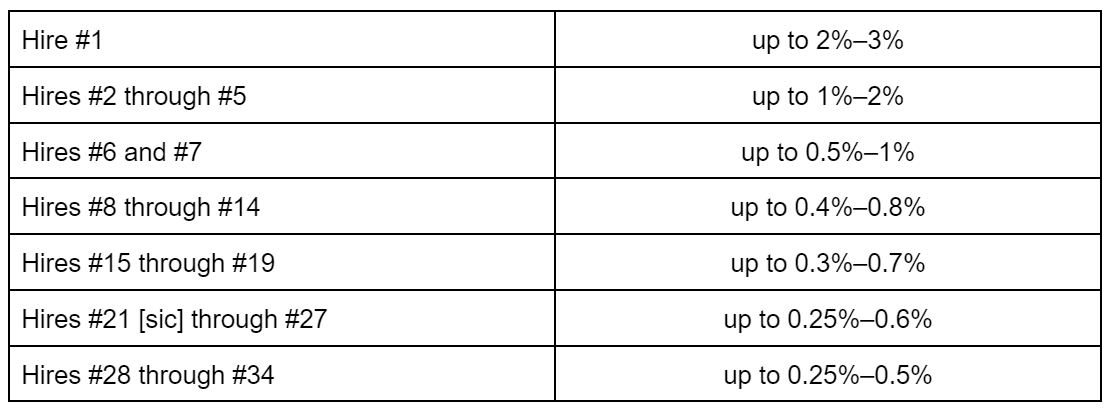
Understanding basis points (bps)
Companies sometimes describe equity grants in basis points (bps) instead of percentages. It's simply another way of expressing ownership.
Basis points | Ownership |
|---|---|
1 bps | 0.01% |
10 bps | 0.10% |
25 bps | 0.25% |
50 bps | 0.50% |
100 bps | 1.00% |
What does that mean in dollars?
Let's say a company is valued at $500 million:
Equity | Ownership | Implied paper value |
|---|---|---|
10 bps | 0.10% | $500,000 |
25 bps | 0.25% | $1,250,000 |
50 bps | 0.50% | $2,500,000 |
100 bps | 1.00% | $5,000,000 |
These figures are simply the ownership percentage multiplied by the company's valuation. They're not guaranteed payouts or necessarily the current value of your options.
The actual amount you receive depends on future company value, dilution, your exercise price, taxes, and investor preferences.
Questions to Ask Once You Get an Offer:
Inspired by Ankur Nagpal's guide to startup equity.
Questions to Ask Once You Get an Offer
Inspired by Ankur Nagpal's guide.
1. What's the last preferred share price and my strike price?
Preferred price: What investors paid per share in the last funding round.
Strike price: What you pay to exercise each stock option.
Estimated paper value = Number of options × (Preferred price − Strike price)
This is a rough comparison tool, not a guaranteed payout.
2. What percentage of the company will I own?
Ownership % = Your shares ÷ Total fully diluted shares × 100
For example, 10,000 shares out of 10 million = 0.10% ownership. Future fundraising can dilute this.
3. What's the company's liquidation preference?
Investors typically get paid before employees when a company sells. If a company raised $100M, investors might be entitled to $100M before common shareholders receive anything. Ask how much is owed and how the payout works.
4. How much will exercising my options cost?
Ask about your total exercise cost, how long you have to exercise after leaving (sometimes just 90 days), and whether you can exercise early.
Also ask about tax implications and QSBS eligibility, which could significantly affect how much you keep.
💰 Signing Bonuses
How To Ask For A Signing Bonus:
Do your research:
Research Average Signing Bonuses on Glassdoor, Levels.FYI, Blind, and other sites
Ask peers in the Leopard Slack to understand typical bonus amounts for your roles or industries (ex: Has anyone asked a seed stage startup for a signing bonus? Would love to hear about your experience")
Possible Leverage:
Competitive Offers: Because of other job offers or you're considering Staying in your current job
Previous Compensation Packages: Consider previous bonuses and overall compensation packages.
Criticality of the Position: High-impact roles may justify higher bonuses.
Unique Skills and Expertise: Specialized skills or certifications can justify a higher signing bonus.
Seniority: More experienced candidates generally command higher bonuses.
How To Figure Out What To Ask For:
Consider the Company's Situation:
Company Size and Financial Health: Larger or financially strong companies may offer higher bonuses.
Hiring Urgency: Companies with urgent hiring needs might offer higher signing bonuses.
Equity vs. Cash: Evaluate if the company offers equity and how it balances with a cash bonus
Sample Calculation Method:
Base Salary: Use your research to identify an average base salary for the role.
Industry Percentage: Determine the average signing bonus percentage in your industry (e.g., 10-20% of the base salary).
Experience Multiplier: Adjust based on your experience (e.g., add 5% for every 5 years of experience).
Location Adjustment: Adjust for cost of living if relocating (e.g., add 5-10% for high-cost areas).
Company Premium: Consider if the company has a history of higher bonuses or if the role is critical.
5% Example Calculation (Tech startups tend to be in the 5% range)
Base Salary: $200,000
Industry Average Signing Bonus: 5% of base salary = $10,000
Experience Adjustment: +10% = $1,000 (for 10 years of experience)
Location Adjustment: +5% = $500 (relocating to a high-cost area)
Company Premium: +5% = $500 (urgent hiring need)
Total Signing Bonus Request: $10,000 + $1,000 + $500 + $500 = $12,000
❌ What You Shouldn't Negotiate For (In Our Opinion)
🌍 Remote Flexibility
We generally don’t recommend asking a primarily in-person company for remote flexibility.
For context, negotiating is almost always okay. You might get a no, but asking respectfully is generally fine — unless the company was explicit about compensation bands throughout the process and/or you already agreed to a number multiple times.
That said, some asks aren’t really about negotiation so much as alignment, and those tend to make companies nervous. Remote vs in-person is one of those. Not saying it’s wrong in all cases, just that it carries more risk than most people realize.
When someone tries to negotiate remote work for an in-person team, we've seen a few things go sideways on the client side (even if none of this is said to the candidate directly):
It can feel like the candidate didn’t fully listen or pay attention during the interview process
It can signal that the candidate won’t enjoy the environment or culture and thus might end up leaving/not working out
It can make the company feel like they invested time in a candidate who may not ultimately accept or like the job
All of this can quietly reduce leverage on other negotiation points, like salary and equity. So we generally recommend focusing on negotiating comp aggressively, and then separately thinking about if the remote/ in office set up works for you, rather than trying to negotiate for it to be different, if that makes sense.
Titles & Promotions
When candidates push hard for a higher title, it can sometimes raise concerns about whether they're the right fit for the role. It's tricky, because of course you need to think about title and career growth during interviews with other companies!
If you don't receive a senior title and were hoping to, it's always ok to ask why you were leveled that way and what it will take to get to the senior level and tying that back to compensation targets during negotiation. But when it comes to trying to negotiate a senior title, we don't recommend it.
Here are reasons that companies don't want to give away senior titles easily:
"Senior" means completely different things at different companies. A Senior Engineer at one place might be considered Mid-level or Staff at another, depending on responsibilities, expectations, and what you've actually accomplished. Because of this, most tech companies do their own assessment during interviews and basically ignore your current title. From their perspective, what matters isn't the label on your offer, it's whether the job's actual responsibilities match how they've defined that level internally. They're measuring you against their system, not your last company's.
Many tech companies are specifically told by their investors and board members to avoid title inflation. The reason is practical: giving someone a title that's too senior creates real organizational problems. It makes hiring more experienced people almost impossible later—you can't bring in the leaders you'll need if those positions are already filled. As companies grow, these early title mistakes can break the whole organizational structure.
When candidates focus heavily on title during negotiation, it can feel like they're optimizing for external status. Real talk: companies want high-impact contributors who care about the business challenges and opportunity. So when a candidate is pushing for a title, rather than asking about the business, it can make hiring teams pause and ask questions like: Will this person be satisfied with the actual work? Are we aligned on what matters?
TLDR: if the title you receive feels lower than expected, the better move is to zoom out and assess the full picture: Does the mission, team, learning opportunities, or financial upside outweigh the title concern? Does the role still align with what matters most in your search? If yes, it's usually worth letting the title go. If not, it may be a signal to keep looking.
Additional Benefits (Health, PTO, Wellness/Mental Health Stipends, etc)
In most cases, individual benefits aren’t designed to be negotiated person by person. They’re part of a standardized system meant to be fair, compliant, and easy to administer across the company. Because benefits are tied to legal, payroll, and insurance constraints, exceptions are often impossible even if the company wants to say yes. It can create internal equity concerns if one person is asking for something others don’t have.
Even when the ask is reasonable, it often puts the company in a position where the answer has to be no, which doesn’t help momentum and rarely improves the rest of the offer. This is usually better treated as an information-gathering conversation than a negotiation lever.
🏆 Negotiation Strategies
🥊 Leverage
Here are a bunch of ideas for leveraging your experience during negotiations:
🛠️ Prior Domain Experience: Mention any previous experience in the same industry or domain as the company, showing your familiarity with the sector and potential to contribute immediately.
Example:"My background in healthcare tech, particularly in developing HIPAA-compliant software, aligns really well with the immediate needs which should hopefully justify me landing in the higher end of the band”
⭐️ Project Experience: Provide examples of past projects that have significant overlap with the company's current or future initiatives.
Example:"Having successfully built and launched three consumer-facing mobile apps from scratch in the app store, I believe I am among the top tier of qualified candidates. Therefore, I would appreciate being leveled accordingly in terms of compensation."
🚀 Startup Experience: If you've worked in a startup environment, stress your adaptability, versatility, and experience in fast-paced settings, which are hard to come by and mean you’ll know how to create value pretty quickly.
Example: "Having served as a founding engineer for a seed-stage SaaS product, I am intimately familiar with the challenges and ready to make an immediate impact. I would appreciate it if my compensation could reflect this experience and expertise."
🎨 Zero-to-One Experience: Highlight your ability to take projects from concept to completion, demonstrating your initiative, creativity, and leadership in bringing new ideas to life.
Example: "Having successfully developed and shipped an analytics dashboard from scratch that is quite similar to [COMPANY]‘s needs, I could imagine that I’m in the top tier of qualified candidates. Therefore, I would be grateful if my compensation could reflect my level of expertise and experience."
🧩 Unique Relevant Experience: Emphasize any rare or specialized skills you possess that set you apart from other candidates and are particularly valuable to the company.
Example: "My dual specialization in blockchain development and mobile development is candidly hard to come by in decentralized finance. I’m hoping this can justify a premium in my compensation."
🔥 Market Demand for Your Skills: Highlight the demand for your skills in the current job market. Mention any trends or reports that show a high demand for engineers with your expertise.
Example: "Candidly, my skills in machine learning and data science are in high demand. Considering the significance of these technologies for your company, I am confident that my expertise warrants a higher salary."
🪜 Crafting a Negotiation Reply:
Thank the company and express enthusiasm: Start the negotiation on a positive note by thanking the company for the job offer and expressing your excitement about the opportunity.
Example: Thank you for offering me the opportunity to join the team at
[Company]as a software engineer. I am excited about the potential to build products for[THEIR CUSTOMER]and to learn more about[SOMETHING COOL]!Mention your Leverage: Highlight your qualifications and achievements, and explain how they align with the company's goals and mission. This can help to demonstrate your value to the company and why you are deserving of a higher salary.
Example: I am confident that my skills and experience, specifically building
[FILL IN UNIQUE SKILLSET]make me a strong fit for this role and that I can contribute significantly to the success of the team.Express your “Reasonable” Ask: Clearly state your salary expectations and provide your data/ research to support your request.
Examples:
"Given my extensive experience in XYZ, I believe a salary adjustment to the 75th percentile of the market rate is reasonable."
"Considering my expertise in ABC technology, which is critical for this project, a re-leveling to the 90% range would be appropriate."
"Given the higher cost of living in this area, I believe a 10% salary adjustment is reasonable."
"Given my commitment to the company's growth, I would like to discuss an increase in my equity stake."
"I'd appreciate an annual budget for professional development courses to enhance my skills in XYZ."
Give them your “Walkaway Number”: Make it clear to the company that if they meet you at your ask you’ll say yes, it makes it clear for them that getting this done is worth their time and will result in a successful outcome.
Positive, Easy Example: If you can meet me at $150,000, I would feel really great about ending my job search and accepting the offer”
Messier Example: Given that the range was initially listed as $150-165k, I am candidly surprised that the final offer is $140k. Unfortunately, I have to respectfully decline this offer and explore other opportunities that align more closely with my financial requirements. If you all are able to meet me at $155k though I am happy to accept.
Offer a tradeoff if you think it’s necessary: If you think the company is unable to meet your salary expectations, consider negotiating other aspects of the offer instead. This could include a signing bonus, education stipend, vacation time, flexible work arrangements, the opportunity to work on specific projects, or other benefits that are important to you. Note that you don’t want to ask for something that is totally out of line, so try to suss out if it’s feasible in conversations to increase your likelihood of getting what you ask for.
Example: If meeting my salary expectation ask of X is not feasible, I am open to the alternative of a signing bonus of $10,000. This would help me offset the expenses incurred during my recent job search, and I would feel fully prepared to begin my new role."
Thank the company and express continued interest: End the negotiation on a positive note by thanking the company for considering your request and expressing your continued interest in the opportunity. This shows that you are professional, respectful, and interested in building a positive relationship with the company.
Example: Thank you again for considering me for this opportunity. I look forward to discussing this further!
📩 Starter Email Templates for Salary Negotiation
🧩 Expressing Enthusiasm and Highlighting Unique Skills
Hey [HIRING MANAGER’S NAME],
Thank you so much again for the offer to join [COMPANY] as a software engineer. I really enjoyed meeting the team and I’m excited about the opportunity to [SOMETHING SPECIFIC YOU ARE EXCITED ABOUT🚀].
I want to be transparent as I review the compensation package. Based on market ranges for similar senior engineering positions and my specific experience with [UNIQUE SKILLSET 🔎] through [EXAMPLE PROJECT 🎨], I’d love to be considered toward the top of the range at $[TARGET NUMBER].
If there’s flexibility to move closer to that range, I’d be happy to accept and move forward. I’m also very open to talking this through live if that’s easier.
OR
I’m very open to talking this through live if that’s easier, and happy to hear your perspective on what flexibility might look like here.
Thanks again for taking the time to consider this. I’m excited about the next steps and hopeful we can land on something that works for everyone.
Best,
[YOUR NAME]
💎 Highlighting Market Demand and Expertise
Hey [Hiring Manager’s Name],
Thank you again for the offer. I really enjoyed meeting the team and I’m excited about [SOMETHING PERSONAL ].
I want to be transparent as I review the compensation package. I’ve been researching market ranges for [STARTUP SIZE/INDUSTRY 🌐] roles and market rates for [SKILLS + YEARS EXPERIENCE 🦄], including data from [SOURCES 📊].
Based on what I’m seeing, I’d feel really great about a salary of $[DESIRED SALARY].
If there’s flexibility to move closer to that range, I’d be happy to accept and move forward. I’m also very open to talking this through live if that’s easier.
OR
I’m very open to talking this through live if that’s easier, and happy to hear your perspective on what flexibility might look like here.
Thanks again for taking the time to consider this. I’m excited about the next steps and hopeful we can land on something that works for everyone!
Best,
[Your Name]
🦄 Asking For More Equity
Hey [HIRING MANAGER’S NAME],
Thank you so much again for the offer to join [COMPANY] as a [POSITION]. I really enjoyed meeting the team and I’m excited about the opportunity to work on [SPECIFIC PROJECT OR AREA].
I want to be transparent as I review the offer. I’m very close to accepting, and I’d love to talk through equity before finalizing. Given my long-term interest in [SOMETHING PERSONAL, MISSION, INDUSTRY ETC ✨], I’d love to be considered for an equity increase from [CURRENT EQUITY GRANT 🌱] to [TARGET EQUITY GRANT ☘️].
If there’s flexibility to move closer to that range, I’d be happy to accept and move forward. I’m also very open to talking this through live if that’s easier.
OR
I’m very open to talking this through live if that’s easier, and happy to hear your perspective on what flexibility might look like here.
Thanks again for taking the time to consider this. I’m excited about the next steps and hopeful we can land on something that works for everyone!
[Your Name]
💰 Addressing a Low Offer with a Counterproposal
Hey [HIRING MANAGER’S NAME],
Thank you again for the offer to join [COMPANY] as a [POSITION]. I really enjoyed meeting the team and I’m excited about the opportunity to contribute to [SPECIFIC GOAL OR PROJECT].
I want to be transparent as I review the compensation package. Based on market ranges for similar roles and my experience with [SPECIFIC SKILLS OR EXPERIENCE 🦄] that map closely to this work, the initial offer of $[OFFERED SALARY] is a bit below what I was expecting.
I totally understand that [COMPANY] is at a different stage as a startup and that compensation won’t map perfectly to market. But given the market ranges I've seen on [SOURCES —GLASSDOOR, LEVELS, JOB LISTINGS, LEOPARD] for [YEARS EXP + STARTUP EXPERIENCE + SPECIFIC SKILLS THEY NEED 🦄] , I’d feel really great about landing at $[NEGOTIATED SALARY 💸].
If there’s flexibility to move closer to that range, I’d be happy to accept and move forward. I’m also very open to talking this through live if that’s easier.
OR
I’m very open to talking this through live if that’s easier, and happy to hear your perspective on what flexibility might look like here.
Thanks so much for taking the time to consider this. I’m excited about the next steps and hopeful we can land on something that works for everyone!
[Your Name]
😡 Addressing a Lower-than-Expected Offer
Hey [HIRING MANAGER’S NAME],
Thank you again for the offer to join [COMPANY] as a [POSITION]. I really enjoyed meeting the team and I’m excited about the opportunity to contribute to [SPECIFIC PROJECT OR GOAL].
I want to be transparent as I review the compensation package. Based on market ranges for senior engineering roles and my experience with [RELEVANT OVERLAP 🦄] that aligns closely with this work, the offered salary of $[OFFERED SALARY] is a bit below what I was expecting.
Based on what I’m seeing, I’d feel really great about landing at a base salary of $[NEGOTIATED SALARY]. I understand there may be constraints, and I’m also open to discussing other ways to bridge the gap, such as a signing bonus or additional equity.
Thanks again for taking the time to consider this. I’m excited about the next steps and hopeful we can land on something that works for everyone.
Best,
[YOUR NAME]
Leopard's Offer Comparison Matrix
Creating a decision matrix can be an effective way to help compare and decide between job offers. How to use:
List the Offers: Write down the job offers you are considering in the top row. Define the Criteria: Determine the factors that are important to you in a job, such as salary, benefits, work-life balance, etc., and list them in the first column.
Assign Scores: Rate each offer on a scale (e.g., 1 to 10) for each criterion based on how well it meets your needs or preferences. You may want to assign weights to each criterion based on its importance to you.
Calculate Total Scores: Add up the scores for each offer to get a total score. Compare and Decide: Look at the total scores to see which offer ranks highest. Consider any additional notes or factors that might influence your decision.
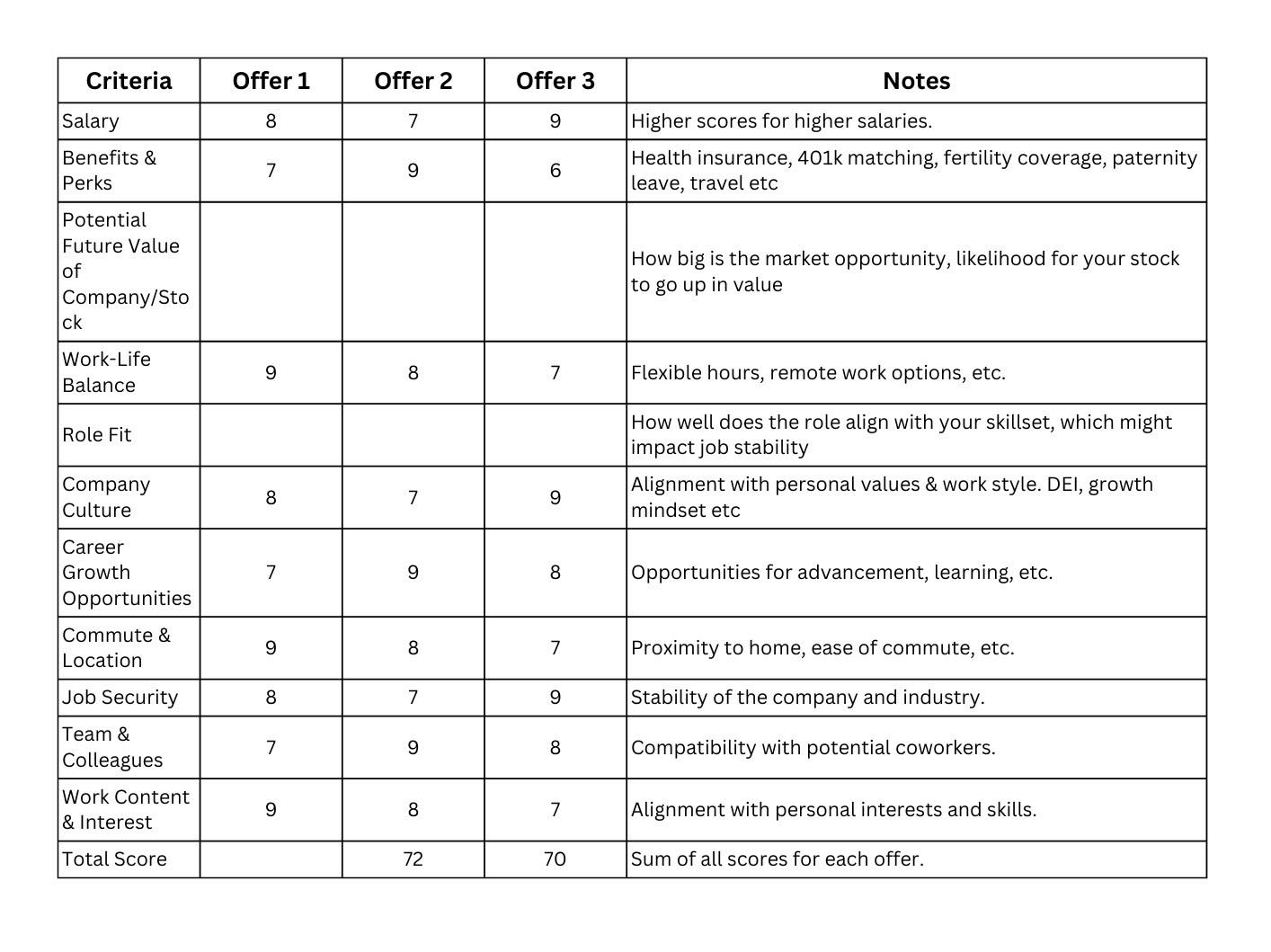
----
Once you’ve watched the video and read this article, feel free to send Lexi a draft of your Negotiation reply and the deadline, and she will send you her edits <3


